Five Mental-Maths Tricks For Time Questions
Time questions turn up in every paper, and children lose marks on them while knowing the maths. Five small habits stop the leak.
Every Olympiad we track finds room for the clock. A duration to work out, a calendar to hop across, a dial written in Roman letters. And time is a strange corner of maths: sixty runs the minutes, twelve runs the hours, seven runs the week, so a child's usual base-ten instincts quietly mislead them. The five habits below each patch one specific leak. None of them takes more than a few minutes to teach.
1. Past Half, Say It Backwards
Once the minute hand crosses the half hour, teach your child to name the time by looking forward, not back. So 3:45 is "quarter to 4", not "forty-five past 3". The paper will phrase it both ways, and the child who can flip comfortably between the two never stumbles on a "quarter to" option.
2. Borrow An Hour Before You Subtract
Finding a duration means subtracting the start from the end, and the minutes usually refuse to cooperate. The fix is borrowing, just like column subtraction. From 3:45 to 5:20, rewrite 5:20 as 4 hours and 80 minutes. Now 80 minus 45 is 35, and 4 minus 3 is 1, so the gap is 1 hour 35 minutes. One borrowed hour makes the whole subtraction friendly.
3. Overshoot The Hour, Then Step Back
Adding 45 or 50 minutes across an hour boundary is where slips happen. Rather than pushing the minutes past sixty, jump a full hour and come back. So 3:20 plus 45 minutes becomes 4:20 minus a quarter of an hour, which is 4:05.
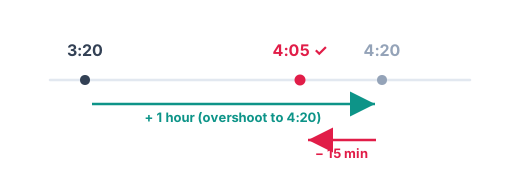
The same move handles "the clock shows 3:20 now, what did it show 45 minutes ago" in reverse: back a full hour to 2:20, then forward 15 to 2:35.
4. Cross A Calendar In Whole Weeks
For "what day of the week is 12 May, if 20 April is a Monday" questions, the shortcut is that seven days later is always the same weekday. Count forward in whole weeks first, then walk the leftover days one at a time. From 20 April, three weeks lands on 11 May, still a Monday, and one more day makes 12 May a Tuesday. No fingers, no listing every date.
5. Read A Roman Clock As Roman Numerals
A clock face with IX at the top-left corner of the questions rattles children who would happily read IX on its own. There is nothing extra to learn: the dial is just the numerals 1 to 12 wearing Roman dress, so IX is 9 o'clock and XI is 11. One wrinkle worth knowing is that many real clock faces write 4 as IIII rather than IV, and papers enjoy asking about exactly that.
Our time chapters carry each of these as its own practice run, so the habits are already automatic when the paper reaches for the clock.
Understanding first. Confidence next.
We teach every topic until it makes sense, then let your child practise it until it sticks. Start with a free diagnostic to see where they stand today.