Cryptarithms, Made Simple
The letter-for-digit puzzle looks impossible and is really a logic ladder. Here is the one habit that cracks almost every one.
- Start at the rightmost column and work left. It has nothing carried into it, so it has the fewest unknowns.
- A carry from one column to the next is always 0 or 1. That is a free fact.
- If the answer has more digits than both addends, the leading digit must be 1.
- Different letters must map to different digits. Check this before writing the answer.
Your child opens the paper, sees something like AB + B7 = 113, and the letters just sit there looking smug. Nothing to add up, nothing to carry, no obvious place to begin. That blank moment is where most children either freeze or start guessing, and guessing almost never lands.
Here is what we tell every child in our reasoning lessons: a cryptarithm is not a guessing game. The same letter always stands for the same digit, two different letters can never share one, and the moment you hold on to that, the wall turns into a staircase. All you have to do is find the bottom step.
Start Where The Puzzle Is Loudest
The bottom step is nearly always the rightmost column, the units. Here is why it is special: nothing is ever carried into it from the right, because there is no column to its right. Every other column might collect a spare 1 from its neighbour, and that extra carry is one more thing you do not yet know. The units column carries no such surprise, so it is the cleanest place to pin down a digit. Work right to left from there, exactly the way your child already adds numbers, and let each column hand over either a digit or a small carry to pass along. Once the first one falls, the rest tend to follow.
Watch One Solve Itself
Take the puzzle from a moment ago: AB + B7 = 113.
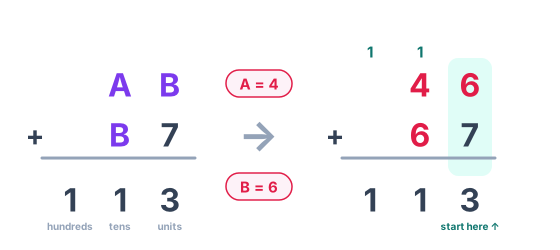
Begin at the units. B and 7 have to add to something ending in 3. A single digit plus 7 can never stretch to 23, so the total has to be 13, which means B is 6. That 13 also quietly hands you a carry of 1 into the next column.
Slide left to the tens. Now you are adding A, the 6 that B turned out to be, and the 1 you carried, and together they need to end in 1. So A plus 7 makes 11, A is 4, and one more carry sets off to the left. That last carry has a whole column to itself, and it settles as the 1 at the front of 113.
Read it back and it holds: 46 + 67 = 113. Nowhere did anyone guess. It was one forced step after another.
The Three Moments A Digit Gives Itself Away
Children get stuck when they cannot spot the next forced step. Almost every time, it is waiting in one of these three places:
- A column with only one value still missing. Take the known digits away from the answer and the last letter has nowhere left to hide.
- A carry, which can only ever be 0 or 1. When two single digits spill over into two digits, the amount carried across is always 1.
- A leading letter, which is never allowed to be zero. If the answer is longer than both numbers being added, that extra front digit has to be a 1.
The Slip That Quietly Costs The Mark
We watch this one happen again and again. A child works nine tenths of the puzzle beautifully, reaches the final letter, and gives it a digit that another letter already owns. Those clashing digits break the one rule the whole thing stands on: different letters, different digits. Before writing the answer down, it is worth ten seconds to check that no two letters have landed on the same number. That single check rescues more marks than any amount of re-adding.
When The Papers Turn Up The Heat
The friendlier boards keep these to a single carry. SilverZone and ITO push harder, with three-digit numbers, two separate sums that share the same letters, or more columns left blank at the start. It can look like a different animal, but it answers to the same handling: find the one column that forces a digit, ink it in, and look again. In our reasoning chapters your child climbs these in order, from a gentle single-carry warm-up to the double cryptarithms the tougher papers now set, so the hard ones feel familiar long before they matter.
Understanding first. Confidence next.
We teach every topic until it makes sense, then let your child practise it until it sticks. Start with a free diagnostic to see where they stand today.