Fast And Slow Clocks, Made Obvious
The fast-clock question appears in almost every paper and quietly costs marks. One sentence fixes it.
- A fast clock is ahead of the truth, so the real time is earlier. Subtract the error.
- A slow clock is behind the truth, so the real time is later. Add the error.
- For the harder version, move the true time along first, then adjust for the fast or slow clock.
- Never do both moves at once. That is where the mark quietly disappears.
Nearly every primary Olympiad hides a clock that runs a little fast or a little slow, then asks for the true time. It looks harmless, and it quietly takes marks off good students all the same. The reason is always the same: the child knows they have to adjust, but freezes on which way. One picture settles it for good.
The Whole Idea In One Picture
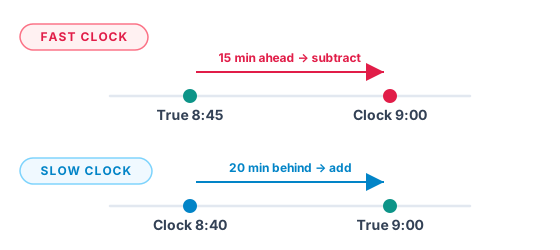
A fast clock has run too far. It sits ahead of the truth, so the real time is a little earlier than what it shows, and you take the error away. A slow clock has fallen behind. It sits behind the truth, so the real time is a little later, and you add the error on. That is the whole rule. Fast clock, take away. Slow clock, add on. Say it out loud once and it tends to stay.
Try The Simple Kind First
A clock is 15 minutes fast and shows 9:00. What is the true time? The clock is ahead of the truth, so the real time is earlier: 9:00 take away 15 minutes is 8:45. One move, done.
Then The Kind That Costs Marks
Here is the version the tougher papers reach for. A clock is 50 minutes fast, and the true time right now is 6:10. What will the clock show after 2 hours?
Do it in two clean moves, never both at once. First move the true time along: 6:10 and 2 hours later is 8:10. Then, and only then, adjust for the clock. A fast clock always shows more than the truth, so add the 50 minutes: 8:10 plus 50 minutes is 9:00. The clock will read 9:00.
The Slip That Costs The Mark
Almost every lost mark here comes from trying to do both moves in one go, juggling the passing time and the clock error together and losing track of one. Keep them apart. Settle the true time first, then fix the fast or slow clock as a separate step. Our time chapters build this up in order, from the single-step question to the two-move version the harder papers favour, until the child stops guessing the direction and simply knows it.
Understanding first. Confidence next.
We teach every topic until it makes sense, then let your child practise it until it sticks. Start with a free diagnostic to see where they stand today.