Understanding Comes First: The Idea Behind Quanta Kids
Good Olympiad prep starts with real understanding, not drilling. That conviction shaped every screen of Quanta Kids. Here is the thinking behind it.
- Most prep tests before it teaches. We flip it, so every topic starts with the idea, not a cold question.
- Each topic is a climb: read it, play it, drill it across three tiers, then beat the boss. Understanding comes before speed.
- The path is tuned to your child's target Olympiad, because SOF, SilverZone and the rest test very different things.
- Parents get plain-English strengths and gaps, like 'work on Fractions next'. No ranks, no jargon.
The idea behind Quanta Kids is simple, and it is the thing I care about most: real understanding is the heart of good Olympiad prep, and everything else follows from it. A child who understands place value, or symmetry, or how a fraction actually works, can handle a question they have never seen before. A child who has only memorised answers freezes the moment the paper changes one small detail.
You see this all the time in the usual way of preparing. A child is handed a paper, does it, gets it marked, and is handed another, on the theory that enough repetition will make the maths stick. For a lot of children it does the opposite. They learn to recognise the shape of a question and reach for a remembered answer, without ever grasping why it is right.
So we built the whole thing to put learning first, and to treat the test as what comes after the learning, not instead of it. Most Olympiad prep does the reverse: it starts at the exam and hopes the understanding turns up along the way. That is backwards. Here is what putting learning first actually looks like, screen by screen.
We Teach Before We Test
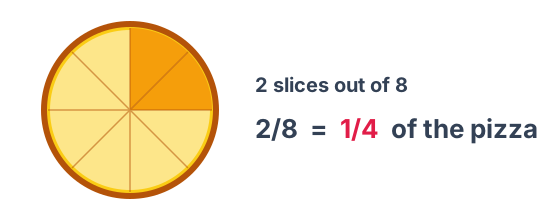
Every topic on Quanta Kids opens with the idea, not a question. Before a child is asked to do anything, they are shown what is going on and why, in plain language and with a picture they can play with. A fraction becomes a pizza they slice and count. A symmetry line becomes a fold you can see. A bar graph becomes bars you read straight off. Only once the idea is on the table do we ask them to use it.
This sounds obvious, and yet almost no Olympiad resource does it. Most start at the test and hope the understanding arrives later. We think that is backwards, and so does every good teacher we have ever met.
Every Topic Is A Climb
A topic is not a worksheet. It is a short climb with four stages, and your child can see exactly where they are on it.
First they read it: the core idea, explained and shown. Then they play it: an interactive version they can poke at until it clicks, rather than a paragraph they skim. Instead of being told that a square has four lines of symmetry, a child folds it on screen and watches each half land exactly on top of the other. The idea stops being a rule to remember and becomes something they have seen with their own eyes. Then they drill it, across three tiers of quests that step up in difficulty, so the jump from "I get it" to "I can do it fast" happens in stages instead of one cliff. And finally they conquer it, facing a boss stage that pulls the whole topic together.
The climb matters because it separates two things most prep muddles together: understanding a concept, and handling it at speed under pressure. We build the first before we ask for the second.
Watch Someone Solve It, Step By Step
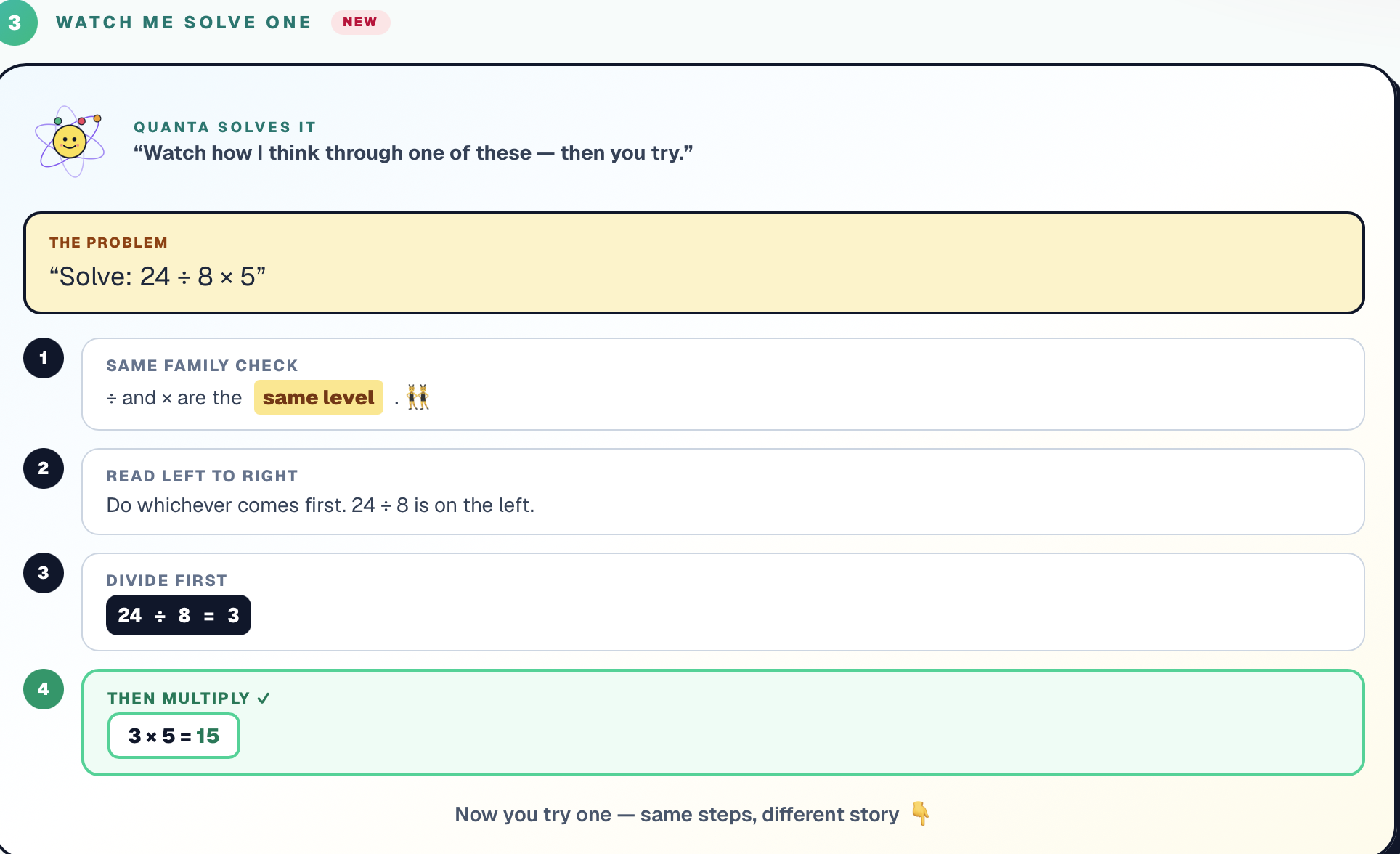
When a child gets stuck, the worst thing to hand them is the answer. It ends the thinking. So the tricky ideas come with a Watch Me Solve One walkthrough, where a friendly guide works a problem out loud, one labelled step at a time. Spot which operations are the same level, read left to right, divide first, then multiply. Your child sees not just the answer, but the thinking that gets there. And then it hands the next one straight back: now you try. That is the part a red pen can never teach.
The Path Is Tuned To Your Olympiad
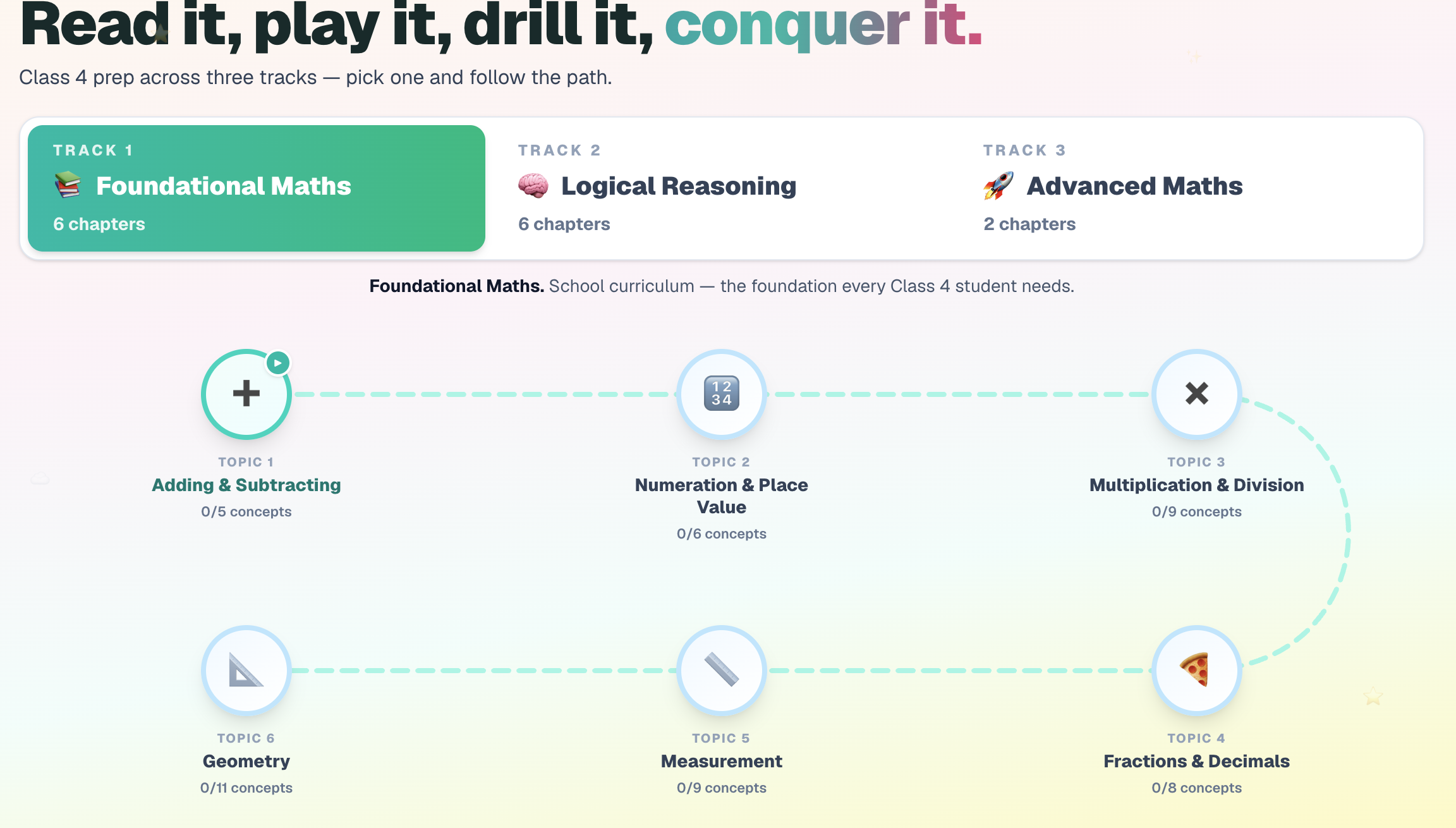
The five Olympiads are not interchangeable. SOF leans on reading and visual reasoning, SilverZone is a formula-driven sprint against the clock, and the others each have their own shape. Preparing for all of them the same way wastes half the effort.
So we start with a ten-minute diagnostic and your child's target exam, and build a path from there. The topics reorder to match what that specific Olympiad actually tests, split across three tracks: Foundational Maths, Logical Reasoning, and Advanced Maths. A child aiming at a reasoning-heavy paper spends more time on reasoning. A child who already has the basics skips ahead. Nobody grinds through what they do not need.
Built For A Child Who Has To Want It
Here is a truth most learning products ignore. When there is no teacher standing over them assigning homework, a young child has to actually want to come back. That is a design problem, not a content problem, and we take it seriously.
So progress is something your child can see and feel: small wins, a streak worth protecting, tiers that unlock, a boss worth beating. What we deliberately left out is just as important. There are no leaderboards and no ranks, because nothing kills a young child's curiosity faster than being shown they are twelfth. The reward is progress against themselves, which is the only comparison that helps at this age.
For Parents, Plain English And No Jargon
You do not need a score out of 40 to know how your child is doing. You need to know what to do next. So the parent view skips the ranks and the percentiles and simply says where your child is strong and where they are stuck, in words you can act on. "Solid on multiplication, work on Fractions next." That is the whole report, and it is worth more than any certificate.
See It For Yourself
We could keep describing it, but the honest test is to watch your own child use it. The ten-minute diagnostic is free and needs no payment to start, and it ends with the plain-English map of strengths and gaps we just described. The first practice paper is free too. Sit your child down with both this week, and you will know within one sitting whether this way of learning suits them. That is a far better basis for deciding than anything we could write here.
Understanding first. Confidence next.
We teach every topic until it makes sense, then let your child practise it until it sticks. Start with a free diagnostic to see where they stand today.