Mirror-Image Questions, Without The Guesswork
Mirror questions punish guessing and reward one simple mental move. Here is how to get them right every time.
- A mirror swaps left and right only. Top and bottom stay exactly where they are.
- Check each option with one question: has left swapped with right, and top been left alone?
- Letters like A, H, I, M, O, T, U, V, W, X and Y look the same mirrored. b, d, p, q, E, F, N, S and Z change.
- The usual wrong answer is the upside-down one, which swaps top and bottom. Rule it out first.
A mirror-image question puts a shape, a letter or a little pattern on the page and asks which of the options is its reflection. Because it looks visual and a bit vague, most children squint at it and guess. There is nothing to guess. A mirror does exactly one thing, and once your child truly sees that one thing, these turn into some of the easiest marks on the paper.
A Mirror Only Does One Thing
Hold this page up to a real mirror along its right-hand edge and watch what happens. Left and right trade places, while top and bottom stay exactly where they were. A shape leaning to the right now leans to the left. A lower-case b becomes d, and p becomes q. Nothing at all moves up or down.
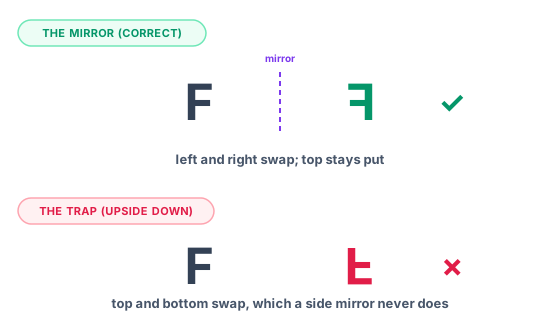
The picture shows it twice. On top is the real mirror flip, where left and right swap over. Below it sits the look-alike that catches children out, where top and bottom have swapped instead. A side mirror never does the bottom one.
The One Question To Ask Every Option
Give your child a single check to run on each choice: have left and right been swapped, with the top left untouched? The reflection is the option where the whole figure has flipped sideways, as though it is hinged on a vertical line straight down the middle. Any option that changed the top or bottom is out.
The Letters That Give It Away
Some letters look identical in a mirror because they are already symmetric down the middle: A, H, I, M, O, T, U, V, W, X and Y. Others change the instant they are reflected, like b, d, p, q, E, F, N, S and Z. Knowing which letters stay put and which ones flip turns a nervous guess into a quick, confident check.
The Look-Alike That Steals The Mark
The most common wrong answer is the upside-down version, the one where top and bottom have been swapped rather than left and right. It looks close enough to feel right, and it is always wrong for a side mirror, so teach your child to spot it and rule it out first. Figures like these only make sense drawn on the page, which is why our reasoning practice ships every mirror question with the real diagram, never a description of it.
Understanding first. Confidence next.
We teach every topic until it makes sense, then let your child practise it until it sticks. Start with a free diagnostic to see where they stand today.