Roman Numeral Arithmetic In Three Steps
Olympiads don't just ask your child to read Roman numerals. They ask them to add and subtract them. Here is the safe method.
- Never calculate inside Roman numerals. Convert to ordinary numbers, do the sum, then convert back.
- There are only seven letters to hold: I, V, X, L, C, D, M for 1, 5, 10, 50, 100, 500 and 1000.
- Subtraction happens in just six pairs: IV, IX, XL, XC, CD and CM. Everything else adds.
- The last mark hides in the final step. Put those six pairs back correctly when writing the answer in Roman.
Most children learn to read a Roman numeral without much trouble. Then a paper slides across something like CMXLIX minus DCCXC, asks for the answer in Roman, and the easy feeling drains away. Now there are letters to take from letters, with no obvious way to line them up.
Here is the secret we share in every numeration lesson: nobody does arithmetic in Roman numerals, not even the examiners who write the questions. The whole move is to step out of Roman completely, do the sum in ordinary numbers, and step back in right at the end.
Never Do The Maths In Roman
Whenever a Roman numeral needs adding, subtracting or comparing, your child reaches for the same three steps, in the same order, every single time:
- Turn each Roman numeral into an ordinary number.
- Add, subtract or compare those numbers the normal way.
- Turn the answer back into Roman.
Think of the Roman letters as a costume the number is wearing. Take the costume off, work with the plain number underneath, and put it back on at the finish.
The Seven Letters, And When They Subtract
There are only seven letters to remember: I is 1, V is 5, X is 10, L is 50, C is 100, D is 500 and M is 1000. Read left to right and you usually just add them up, so VI is 5 and 1, which makes 6.
The one twist is subtraction. When a smaller letter sits in front of a larger one, you take it away instead, and this happens in only six pairs worth learning by heart: IV is 4, IX is 9, XL is 40, XC is 90, CD is 400 and CM is 900. Anything that is not one of those six pairs is a plain addition.
One Sum, Start To Finish
Take the puzzle from the top: CMXLIX minus DCCXC.
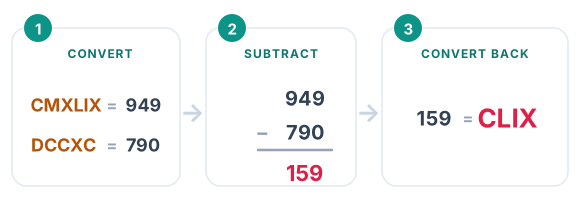
Step one, convert. CMXLIX is 900 and 40 and 9, so 949. DCCXC is 500 and 200 and 90, so 790.
Step two, subtract in ordinary numbers. 949 minus 790 is 159.
Step three, convert back. 159 is 100, then 50, then 9, which is C, L and IX joined together: CLIX.
Nowhere did anyone take a letter away from a letter. The hard-looking Roman sum quietly became a plain one your child could already do.
The Slip That Costs The Mark
The children who lose marks here are the ones who try to work inside the Roman letters, cancelling them against each other and hoping it balances. It almost never does. Convert first, always. Once the numbers are ordinary, the sum is ordinary too, and the only real care needed comes at the very end, when those six subtraction pairs have to go back in correctly.
When The Papers Push Further
Friendlier papers keep the numbers small. SilverZone and the tougher boards reach into the hundreds and thousands, tuck a Roman numeral inside a longer word problem, or ask your child to compare two of them rather than add. The three steps never change. Convert, compute, convert back, and the biggest number on the page is no scarier than the smallest. Our numeration chapters drill this habit until your child stops seeing letters and starts seeing the number hiding inside.
Understanding first. Confidence next.
We teach every topic until it makes sense, then let your child practise it until it sticks. Start with a free diagnostic to see where they stand today.