SilverZone iOM Class 3: What To Expect In The Paper
The maths stays on the school syllabus, but the clock is tight and the last five questions still bite. Here is the real shape of Class 3 iOM, the puzzles that come back every year, and how Level 2 raises the bar.
- SilverZone iOM Class 3 is 30 questions in 40 minutes. There is no beyond-grade content at Level 1, so the maths stays squarely on the school syllabus.
- Measurement is the biggest strand of the paper: length, weight and capacity fill a good part of Section A.
- The signature puzzles are a capacity chain, a balance scale, a cube stack, a letter code that grows one step at a time, and a column match.
- Level 2 is where it hardens, adding prime numbers, verbal analogies, directions and a tougher second cryptarithm.
If your child is taking SilverZone iOM in Class 3, the maths stays on the school syllabus, so there are no surprises from beyond the grade. But do not mistake on-syllabus for easy: the clock is tight and the last five questions bite. Knowing the shape of the paper in advance takes away most of the surprise.
The Short Version
Two things decide how a Class 3 child does here. The first is measurement. Length, weight and capacity between them fill a large part of Section A, more than any other single strand, so a child who is fluent with centimetres, grams and millilitres starts with a real advantage. The second is pace. There is a lot of straightforward maths to get through in forty minutes, and marks are lost to the clock far more often than to the difficulty of any one sum. Fix those two and the rest of the paper looks after itself.
The Format
SilverZone iOM Class 3 runs 30 questions in 40 minutes, for 100 marks, split across three sections.
- Section A, Mathematics: 20 questions, the body of the paper.
- Section B, Reasoning and Aptitude: 5 questions.
- Section C, Scholar's Zone: 5 questions, the hardest, worth the most marks each.
The marks rise as you move through the sections, so a Scholar's Zone question is worth well more than a Section A one, and the whole paper adds to a clean 100. Four options per question, and no negative marking, so a blank is never better than a guess. At Class 3, SilverZone sets a single version of the paper, so there is no Set A or Set B to think about.
The Clock
The number to keep in mind is forty minutes. That is less time per question than the hour most other Olympiads allow, and the questions are not one-liners. This paper rewards quick, accurate work: tables known cold, unit conversions done without pausing. A child who is still counting on fingers will not run out of maths, they will run out of time. Practise against the clock, not just for accuracy, so the pressure is familiar before the day.
What Each Section Tests
Section A is school maths at pace. Expect place value and number names, reading an abacus, ordering and comparing numbers, four-digit addition and subtraction dressed as word problems, some multiplication and division, and a good run of fractions, whether shaded, equivalent, or the odd one out. Then the measurement block that carries so much weight: length in centimetres and millimetres, weight in kilograms and grams, capacity in litres and millilitres. Rounding it off are time and the calendar, money and change, a little geometry of lines and shapes, and a pictograph or bar graph to read.
Section B is the reasoning block: a pattern or odd-one-out, a letter code to crack, a how-many-triangles figure, a tallest-to-shortest comparison, and a direction question.
Section C, the Scholar's Zone, is where the paper shows its teeth. Five questions, each worth the most marks, and each usually folding two steps into one problem.
The Questions You'll See Again And Again
Sort a few years of Class 3 papers and the same shapes keep returning. Meet these at home and little on the day will surprise your child.
- A capacity chain. One jug fills three glasses, two glasses hold a known amount, so how much do four jugs hold? A measurement puzzle to follow one link at a time, and it leans on the litres-and-millilitres work from Section A.
- A balance scale. Two apples weigh the same as three plums, and you are asked to compare them or find a missing weight. It rewards a child who can hold a simple relationship in their head.
- A cube count. A little staircase or L-shaped stack of identical cubes, and the job is to count them all, including the ones you cannot see. Children who count only the front face lose the mark.
- A letter code that grows. A word is given a value one letter at a time, so the code for a short word builds up to the code for a longer one, and your child has to spot the rule. It looks like reading but it is pattern-finding.
- A column match. A short list of facts on one side, a list of values on the other, and every pairing has to be right to score. One wrong link takes down the whole answer, so this is the place to slow down.
- A pictograph with a key. One picture stands for several things, five children or ten books, and the trap is reading the pictures without multiplying by the key. Two of these usually appear.
Try One Yourself
Here is the flavour, a capacity chain of the kind that carries so many of the marks in Section A. One jug fills 3 glasses, and 2 glasses hold 500 ml. How much do 4 jugs hold?
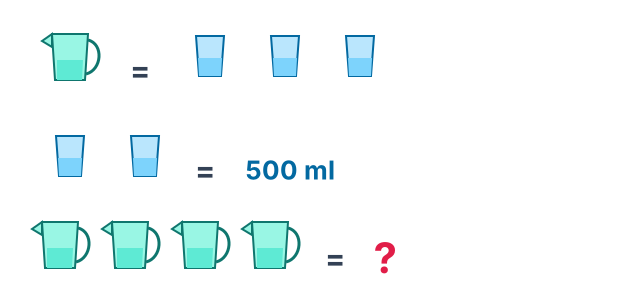
Follow it one link at a time. If 2 glasses hold 500 ml, then 1 glass holds 250 ml. One jug fills 3 glasses, so a jug holds 750 ml. And 4 jugs hold four times that, which is 3000 ml, or 3 litres.
The trap is to rush a link, multiplying or dividing by the wrong number partway through, and the whole answer falls with it. Written out slowly the path is clear. Now picture your child meeting it as question 11 of 30, with the clock ticking, holding litres and millilitres steady while they work through each step. That gap, between following the chain calmly and handling it at speed, is the whole game at Class 3.
If Your Child Reaches Level 2
Level 2 is a separate, selective round, not a paper every child sits. Broadly, only the top rank holders in each class who also scored at least 50% at Level 1 are invited, so reaching it is an achievement in itself. The paper keeps the same 30-question shape, but reaches further. The recent papers have raised the bar, and the 2025 paper in particular added a good deal at once. Expect prime and composite numbers, angle names like isosceles and obtuse, a verbal analogy (painter is to canvas as writer is to which word?), and a direction question that asks for a quarter turn. The number series get trickier too, the kind that grow by a rule rather than a fixed step, such as doubling and then adding a little each time. And the cryptarithm, the letters-for-digits puzzle that always turns up once, has started coming in pairs. SilverZone nudges the difficulty up most years, so treat Level 2 as a moving target and prepare a notch above last year's paper.
How To Get Ready
Make the measurement work automatic first, since it carries the most marks: converting between centimetres and millimetres, grams and kilograms, litres and millilitres, without stopping to think. Then practise the signature puzzles above, because a child who has already met a capacity chain or a balance scale will not freeze when the real one appears. Use real figures rather than descriptions, since pictographs, cube stacks and shapes only make sense on the page. And do a few runs against the clock, building up to the full forty minutes rather than meeting it cold.
Here is the honest snag most parents hit. Good, current SilverZone practice at Class 3 is hard to find. The questions are scattered across workbooks, much of what is online is recycled or years out of date, and very little of it reflects the higher bar of the recent papers.
That is the gap our SilverZone practice papers were built to fill. They follow the current 30-question Class 3 format, with fresh questions written to the latest difficulty, worked solutions for every one, and the signature question types above woven in on purpose. If you would rather start by seeing where your child stands, the ten-minute diagnostic is free and ends with a plain-English map of their strengths and gaps. The first practice paper is free too, so you can sit your child down this week and find out exactly where they are before spending anything.
Understanding first. Confidence next.
We teach every topic until it makes sense, then let your child practise it until it sticks. Start with a free diagnostic to see where they stand today.