SilverZone iOM Class 4: What To Expect In The Paper
SilverZone iOM Class 4 is fast, formula-driven and heavy on geometry, and the format changed a few years ago in a way that catches parents using old books. Here is the real shape of the exam and the questions that come back every year.
- SilverZone iOM Class 4 is 30 questions in 40 minutes. Older practice books show a 50-question paper, which is the wrong format now.
- Geometry carries the most marks: compound figures, angles, and counting lines, rays and segments.
- The maths is standard Class 4, but tested from a harder angle: Roman numerals to compare not just convert, bigger numbers, and multi-step decimal work.
- A symbol equation and a cryptarithm show up on almost every paper, so treat them as regulars, not surprises.
If your child is taking SilverZone iOM in Class 4, the paper is fast, formula-driven and heavy on geometry. Most of the maths is standard Class 4 content, but the questions come at it from a harder angle and move at speed. Knowing the shape in advance takes away most of the surprise, and it also saves you from one common trap we will come to first.
The Short Version
Geometry is where the marks concentrate at Class 4. Compound figures, angles, area and perimeter, and the quiet favourite of counting lines, rays and segments in a drawing, together make up the largest share of the paper. Fractions have grown heavier too in the current format. And running underneath it all is the clock: forty minutes for thirty questions that take working out. A child who is quick and accurate with school methods, and comfortable reading a figure, is set up well. Fix geometry and pace first.
The Format
SilverZone iOM Class 4 runs 30 questions in 40 minutes, for 100 marks, across three sections.
- Section A, Mathematics: 20 questions.
- Section B, Reasoning and Aptitude: 5 questions.
- Section C, Scholar's Zone: 5 questions, the hardest, worth the most marks each.
Four options per question, no negative marking, and the marks rise section by section to a clean 100.
One warning worth heeding. SilverZone changed the Class 4 paper a few years ago, from a longer fifty-question paper with five options down to today's thirty questions with four. A lot of the practice books and free downloads still floating around show the old fifty-question shape. If your child practises on those, they are preparing for a paper that no longer exists. Make sure whatever you use follows the current 30-question format.
The Clock
Forty minutes is the number that matters. That is less time per question than the hour most other Olympiads give, and these questions take working out. The paper rewards a child whose tables, column arithmetic and unit conversions are automatic, and it is unkind to one who needs to stop and puzzle out each step. Build up to the full forty minutes in practice so the pressure is familiar.
What Each Section Tests
Section A is school maths at pace, but weighted towards geometry. Expect angles and shape properties, the area and perimeter of compound figures, and line, ray and segment counting. Around that sit a strong run of fractions, multi-step word problems and operations, a couple of decimal questions, some number sense with Roman numerals and larger numbers than the classroom usually reaches, and a data-handling question or two.
Section B is the reasoning block: a number or letter series, a coding question, a direction or ranking puzzle, and a figure to analyse.
Section C, the Scholar's Zone, is the hardest five. Each question is worth the most marks on the paper, and each tends to stitch two ideas together: a compound figure whose dimensions you have to work out before you can use them, or a multi-fact problem where every part has to be right.
The Questions You'll See Again And Again
Sort a few years of Class 4 papers and the same shapes return.
- A compound figure. The perimeter or area of a shape built from several rectangles or squares, or two shapes compared across four option diagrams. No single formula solves it, so it rewards careful tracing over habit.
- A line, ray and segment count. One drawing, and the job is to count how many line segments or rays it contains. Simple to state, easy to undercount.
- A symbol equation. Shapes standing in for numbers, one equation to find a shape's value, then a second that uses it. It is algebra in disguise, and there is almost always one.
- A cryptarithm or long-division puzzle. Letters or blanks standing for digits, solved by logic rather than calculation. Recent papers rarely skip it.
- A decimal question with a twist. Not a single clean sum, but reading a decimal carefully or mixing several decimal operations in one problem.
- A large-number or Roman question. Reading or comparing bigger numbers than the classroom usually reaches, or comparing values written as Roman numerals rather than simply converting them.
- A match-the-column or multi-fact money problem, the Scholar's Zone staple, where one wrong pairing loses the whole mark.
Try One Yourself
Here is the flavour, a symbol equation of the kind that turns up in Section A. Three of the same shape add to one total, and the shape paired with a second shape adds to another. What is the second shape worth?
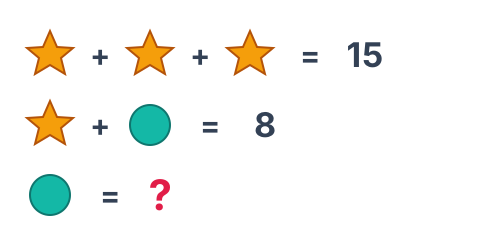
Three stars make 15, so one star is 5. A star and a circle make 8, so the circle is 3. Written out slowly it is clearly algebra with the letters swapped for pictures. The difficulty on the day is not the idea, it is doing this cleanly as one of thirty questions with the clock running. A child who has met the shape before solves it in seconds. One seeing it for the first time loses a minute deciding what it even is.
What Qualifying For Level 2 Takes
If your child does well at Level 1, they may be invited to Level 2, and it helps to know what that is. Level 1 is open to every child who enters. Level 2 is not: it is a separate, selective round, and broadly only the top rank holders in each class who also scored at least 50% at Level 1 are called. The paper keeps the same 30-question shape, but it is sat by a stronger field, and it pushes the same topics a step harder, with tougher compound figures, comparisons in Roman numerals, and multi-step number work. Geometry stays dominant, and the cryptarithm and symbol equation remain fixtures. SilverZone tends to raise the bar a little each year, so prepare a notch above the most recent paper rather than an old one.
How To Get Ready
Put geometry first, since it carries the most marks: angles, the area and perimeter of compound shapes, and careful line, ray and segment counting on real drawings. Make the school methods automatic, so the trickier decimal and large-number questions do not eat the time the Scholar's Zone needs. Treat the symbol equation and the cryptarithm as regulars and practise them until they feel routine. And use figures rather than descriptions, because compound shapes only make sense on the page.
Here is the honest snag most parents hit. Good, current SilverZone practice at Class 4 is hard to find, and worse, a lot of what is out there is the old fifty-question format. So parents end up drilling their child on a paper the exam has already moved past.
That is the gap our SilverZone practice papers were built to fill. They follow the current 30-question Class 4 format, with fresh questions written to the latest difficulty, worked solutions for every one, and the signature question types above woven in on purpose. If you would rather start by seeing where your child stands, the ten-minute diagnostic is free and ends with a plain-English map of their strengths and gaps. The first practice paper is free too, so you can find out exactly where they are this week before spending anything.
Common Questions
What is the format of the SilverZone iOM Class 4 paper?
SilverZone iOM Class 4 is 30 questions in 40 minutes for 100 marks, across three sections: Mathematics with 20 questions, Reasoning and Aptitude with 5, and the harder Scholar's Zone with 5. There are four options per question and no negative marking.
Is SilverZone iOM Class 4 still a 50-question paper?
No. SilverZone changed the paper a few years ago, from a 50-question paper with five options down to today's 30 questions with four. A lot of old practice books and free downloads still show the outdated 50-question format, so check whatever you use follows the current one.
Which topic carries the most marks in SilverZone iOM Class 4?
Geometry: compound figures, angles, area and perimeter, and counting lines, rays and segments in a drawing. Fractions have grown heavier too in the current format.
Why is SilverZone iOM considered hard?
The clock as much as the questions. Forty minutes for thirty questions that take working out is less time per question than most Olympiads give, so it rewards a child whose tables, arithmetic and unit conversions are quick and close to automatic.
Understanding first. Confidence next.
We teach every topic until it makes sense, then let your child practise it until it sticks. Start with a free diagnostic to see where they stand today.