SilverZone iOM Class 5: What To Expect In The Paper
The maths is standard Class 5 content, but SilverZone tests it fast and from the harder angle. Here is the real shape of the paper, the questions that come back every year, and what qualifying for Level 2 really takes.
- SilverZone iOM Class 5 is 30 questions in 40 minutes, across three sections, with the Scholar's Zone worth the most marks each.
- The topics are standard for Class 5. What catches strong students is the angle: percentages asked in reverse, journeys needing an average speed, areas with a curve hidden inside.
- Fractions, decimals and geometry with shapes inside shapes carry the most marks.
- Level 2 is a separate, selective round. Only the top rank holders in each class who also score at least 50% at Level 1 are invited.
If your child is taking SilverZone iOM in Class 5, the maths itself is standard Class 5 content. What makes the paper hard is not exotic topics, it is the pace and the angle: fast, formula-driven questions that often come at a familiar idea from the harder direction. Knowing its shape in advance takes away most of the surprise.
What The Paper Looks Like
SilverZone iOM Class 5 runs 30 questions in 40 minutes, for 100 marks, across three sections.
- Section A, Mathematics: 20 questions.
- Section B, Reasoning and Aptitude: 5 questions.
- Section C, Scholar's Zone: 5 questions, the hardest, worth the most marks each.
Four options per question, no negative marking, and the marks climb section by section to a clean 100. SilverZone runs the exam on more than one date, so schools can pick a slot that suits them, and each date has its own paper. That is why you may see a set code such as AA, BB or CC on the sheet. It tells you which sitting the paper belongs to, not how hard it is, so there is nothing to read into which one your child gets.
The number that shapes everything is the forty minutes. That is less time per question than the hour most other Olympiads allow, and at Class 5 the questions are longer, because a percentage or a time-and-distance problem takes real working. There are twenty of that kind of thing in Section A alone before the harder five at the end. The paper rewards a child who is quick and accurate with standard methods and does not have to rediscover them mid-question, so build up to the full forty minutes in practice well before the day.
Where The Marks Live
Section A is the body of the paper. Expect a strong run of fractions and decimals: comparing, operating, sometimes working backwards to find the original. Geometry and mensuration with angles, composite area and perimeter. And the topics that give Class 5 its edge: a percentage, often a reverse or comparative one, a ratio, a time-and-distance sum with an average speed, and now and then a simple equation or an exponent. A data-handling question or two closes it out.
Section B is the reasoning block: number-grid patterns, an analogy, a coding question, a direction puzzle, and some cube counting or a mirror image.
Section C, the Scholar's Zone, is the hardest five, and this is where the paper stretches furthest. Expect a shaded fraction compared across two figures, a composite area with a semicircle, concentric squares, an income-and-expenditure ratio system, or a pictorial puzzle where different shapes stand for weights and you solve for one. Each folds two or three ideas into a single question.
The Twist Is In The Question, Not The Topic
Here is the thing that surprises many parents. The topics on this paper are not unusual for Class 5. Fractions and decimals, percentages, ratio, time and distance, area and perimeter are all standard grade content. What catches a strong child is the angle each question takes. A percentage is asked in reverse rather than forwards. An area question hides a semicircle inside a rectangle. A journey needs an average speed, not a single one. The content is familiar, but each question takes it a step further than the classroom version, and handling that at speed is the real test.
These are the shapes that come back year after year.
- A reverse percentage. Not just find twenty percent of a number, but the harder direction: this amount is twenty percent, so what is the whole? Or a comparison, where a quarter of one quantity equals three-quarters of another.
- A ratio or proportion. A quantity split in a given ratio, or a chained one where two ratios have to be joined before you can answer.
- A time, speed and distance question, often with an average speed over two legs of a journey, which children tend to get wrong by adding the two speeds and halving.
- A composite area with a curve. A rectangle with a semicircle added or removed, or a shaded region between two shapes, where one formula will not reach the answer.
- A shapes-for-weights puzzle. Different symbols stand for different values on a balance, and you solve the little system to find one. It is algebra with pictures.
- A cryptarithm. Letters standing for digits in a column sum, solved by logic. Class 5 papers almost always carry one, and the harder papers carry two.
- A match-the-column or income-expenditure problem in the Scholar's Zone, where every part has to be right to score the mark.
Try One Yourself
Here is the flavour, a reverse percentage of the kind that turns up in Section A. A child has read 40 pages of a book, and that is twenty percent of the whole book. How many pages does the book have?
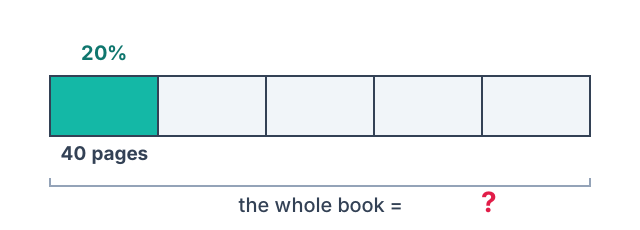
The trap is to find twenty percent of 40 and answer 8. But 40 is the twenty percent. If twenty percent is 40 pages, then the whole is five times as much, so the book is 200 pages. Written out slowly the logic is clear. The difficulty on the day is spotting which way round the question runs, quickly, as one of thirty, with the clock going. A child who has only ever been asked to find a percentage of a number, and never to work back from one, loses time just deciding what the question wants.
What Qualifying For Level 2 Takes
If your child does well at Level 1, they may be invited to Level 2, and it is worth being clear about what that is, because it is often misunderstood. Level 1 is open to every child who enters. Level 2 is not. It is a separate, selective round, and only a small group is called: broadly, the top rank holders in each class who also scored at least 50% at Level 1. So clearing Level 1 is not a formality that leads into Level 2. It is a genuine hurdle, and reaching Level 2 is itself an achievement worth aiming for.
The Level 2 paper keeps the same 30-question shape, but it is sat by a much stronger field, so the competition is far tighter than the questions alone would suggest. Prepare for it by deepening the same topics rather than expecting an entirely new syllabus, and treat qualifying, not just taking part, as the goal.
How To Get Ready
Start with fraction and decimal fluency, since they run through the whole paper. Then practise the harder angle these topics get tested from: percentages worked backwards, ratios that chain together, and journeys that need an average speed rather than a single one. Practise the composite-area questions on real figures, since a semicircle cut into a rectangle only makes sense on the page. Treat the cryptarithm and the shapes-for-weights puzzle as regulars. And do timed runs, building up to the full forty minutes, so the pace is familiar.
Here is the honest snag most parents hit. Good, current SilverZone practice at Class 5 is hard to find, especially practice that includes percentage, ratio and time-and-distance questions pitched at the right level. Much of what is online is recycled, out of date, or aimed at the wrong difficulty.
That is the gap our SilverZone practice papers were built to fill. They follow the current 30-question Class 5 format, with fresh questions written to the latest difficulty, worked solutions for every one, and the signature question types above woven in on purpose. If you would rather start by seeing where your child stands, the ten-minute diagnostic is free and ends with a plain-English map of their strengths and gaps. The first practice paper is free too, so you can find out exactly where they are this week before spending anything.
Understanding first. Confidence next.
We teach every topic until it makes sense, then let your child practise it until it sticks. Start with a free diagnostic to see where they stand today.