Teaching Fractions With Cake, Coins And Dinner Plates
Fractions on paper are abstract. Fractions on the dinner table are obvious. Three household objects do the teaching for you.
- Anything cut into equal slices teaches what a fraction is. Two of eight slices, and 2/8 = 1/4 explains itself.
- Money makes different denominators friendly: half of ₹20 plus a quarter of ₹20 is ₹15, which is three quarters.
- Serving food turns 'of' into an action. One third of twelve peas is a scoop, not a sum.
- Let the object answer first, then write the maths that says the same thing.
Here is a small experiment for tonight. Write 2/8 = 1/4 on a piece of paper and ask your child if it is true. You will probably get a shrug. Then cut something round into eight equal slices, hand over two of them, and ask what share of the whole they got. Somewhere between the first and second bite, the same equation stops being a claim and becomes something they saw happen.
That gap between the shrug and the bite is the whole story of fractions at this age. On paper a fraction is two stacked numbers obeying rules nobody explained. On the table it is just a fair share. Three ordinary objects carry almost the entire syllabus.
Start With Anything You Can Slice
Cake, pizza, roti, an apple. The moment food is cut into equal pieces, the denominator has a meaning: how many pieces the whole was cut into. The numerator is simply how many pieces landed on your plate.
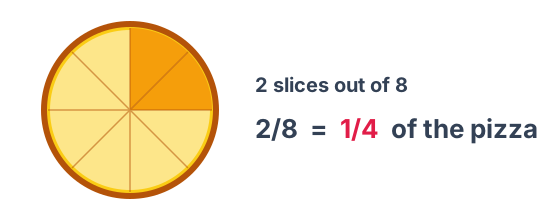
Two slices of an eight-slice pizza and a quarter of the same pizza are the same amount of dinner, and a child who has held both in their hands has understood equivalent fractions before ever hearing the phrase. That is the idea Olympiad papers dress up in shaded circles and rectangles, and your child will recognise it as an old friend.
Move To Coins When Denominators Disagree
Adding a half to a quarter is the point where paper fractions usually lose the room, because halves and quarters refuse to line up. Money lines them up instantly. Take ₹20. Half of it is ₹10. A quarter of it is ₹5. Together that is ₹15, and anyone can see ₹15 is three quarters of ₹20. So a half plus a quarter must be three quarters.
What just happened, quietly, is that rupees played the role of a common denominator. When the school method of matching denominators arrives later, it will describe something your child has already done at the shop counter.
Let The Dinner Plate Handle "Of"
The word "of" carries a lot of Olympiad questions: one third of 12, three quarters of 20, half of what remains. At the table, "of" is not a maths word at all. "Eat one third of your twelve peas" is an instruction, and a child who splits twelve peas into three groups of four and eats one group has just computed one third of 12 without noticing.
That is the whole trick, and it runs in one direction: object first, symbols second. Once the plate has answered, write the fraction that says the same thing, and the notation becomes a label for something real. Our fraction chapters are built in that same order, picture first and rule second, so the classroom version lands on ground the dinner table has already prepared.
Understanding first. Confidence next.
We teach every topic until it makes sense, then let your child practise it until it sticks. Start with a free diagnostic to see where they stand today.